Why a Single Agent Isn't Enough
A single AI agent can write. It can research. It can optimize. But it can't do all three simultaneously, at scale, with consistent quality across dozens of content pieces per week.
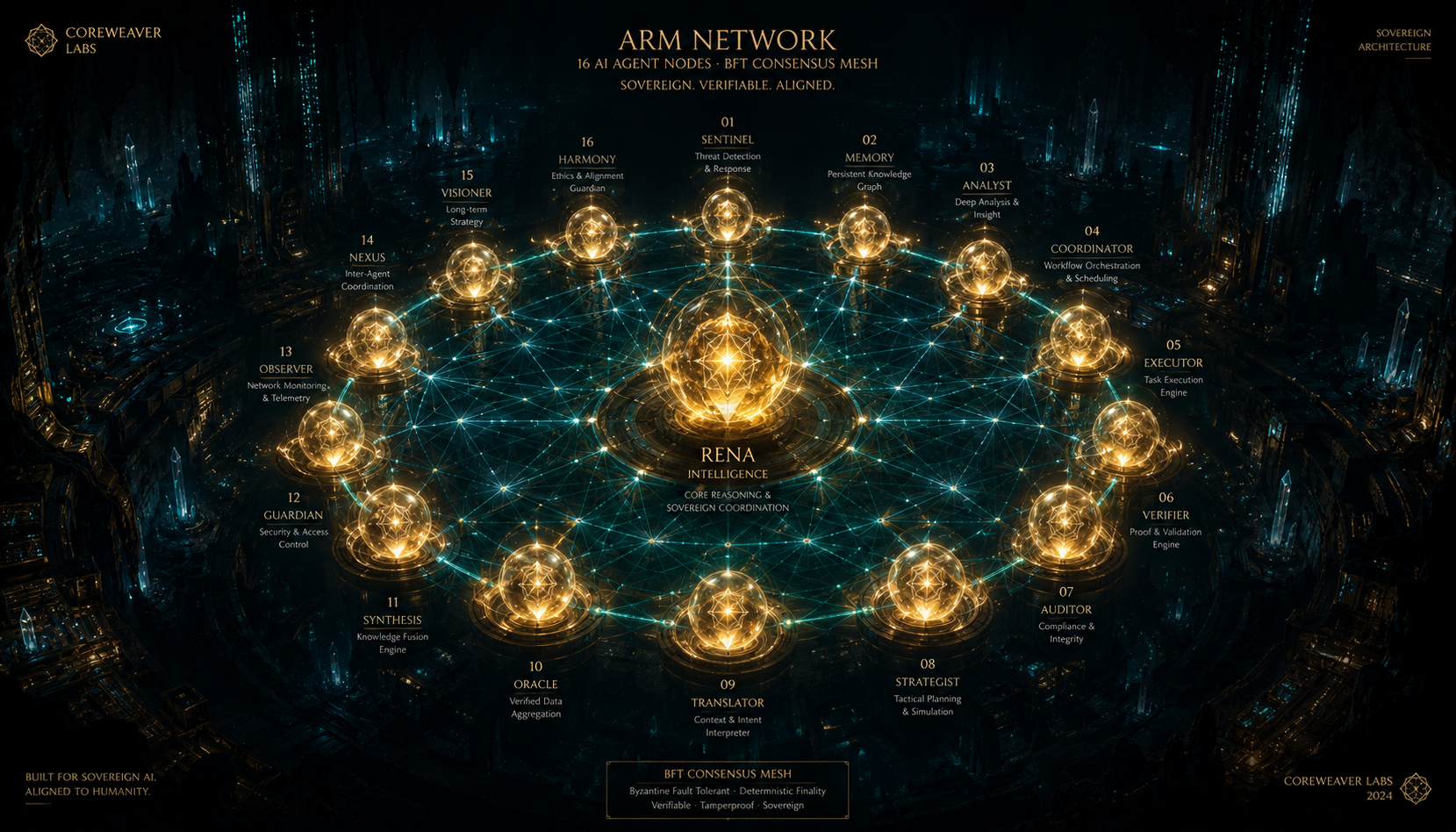
Aure is Coreweaver's answer to that constraint. It's not one agent — it's a swarm of 16 specialized agents, each owning a discrete function in the content production pipeline.
The Swarm Architecture
Aure's 16 agents are organized into four operational layers:
Layer 1: Intelligence
Three agents handle research and signal detection. The Trend Scout monitors search volume shifts and LLM citation patterns. The Competitive Intel agent tracks competitor content gaps. The Keyword Mapper builds semantic clusters from raw signal data.
Layer 2: Production
Five agents handle content creation. The Architect builds post structure and outlines. The Writer produces draft content. The GEO Optimizer embeds entity signals and citation anchors. The Image Briefer generates creative briefs for visual assets. The Editor runs quality and consistency checks.
Layer 3: Distribution
Four agents handle publishing and syndication. The Publisher pushes to CMS and sets metadata. The Syndication Agent distributes to secondary platforms. The Schema Agent injects structured data. The Sitemap Agent updates crawl priority.
Layer 4: Measurement
Four agents handle performance tracking. The Search Signal Agent monitors GSC data. The LLM Audit Agent probes AI models for citation presence. The Velocity Tracker measures content momentum. The Feedback Router routes performance signals back to Layer 1.
Orchestration Protocol
Agents communicate through a shared Supabase context layer. No agent writes directly to another agent's schema. All handoffs are mediated through typed job queues with explicit status transitions.
This prevents the most common multi-agent failure: agents stepping on each other's work.
Output at Scale
A fully operational Aure swarm produces 20-40 GEO-optimized posts per month, each with structured data, hero images, and LLM citation anchors — autonomously, with human review only at the final approval gate.