What Makes an AI Agent Accountable?
Most AI agent frameworks focus on capability — what the agent can do. The ARM Framework focuses on something harder: what the agent is responsible for, and whether it can be held to that responsibility.
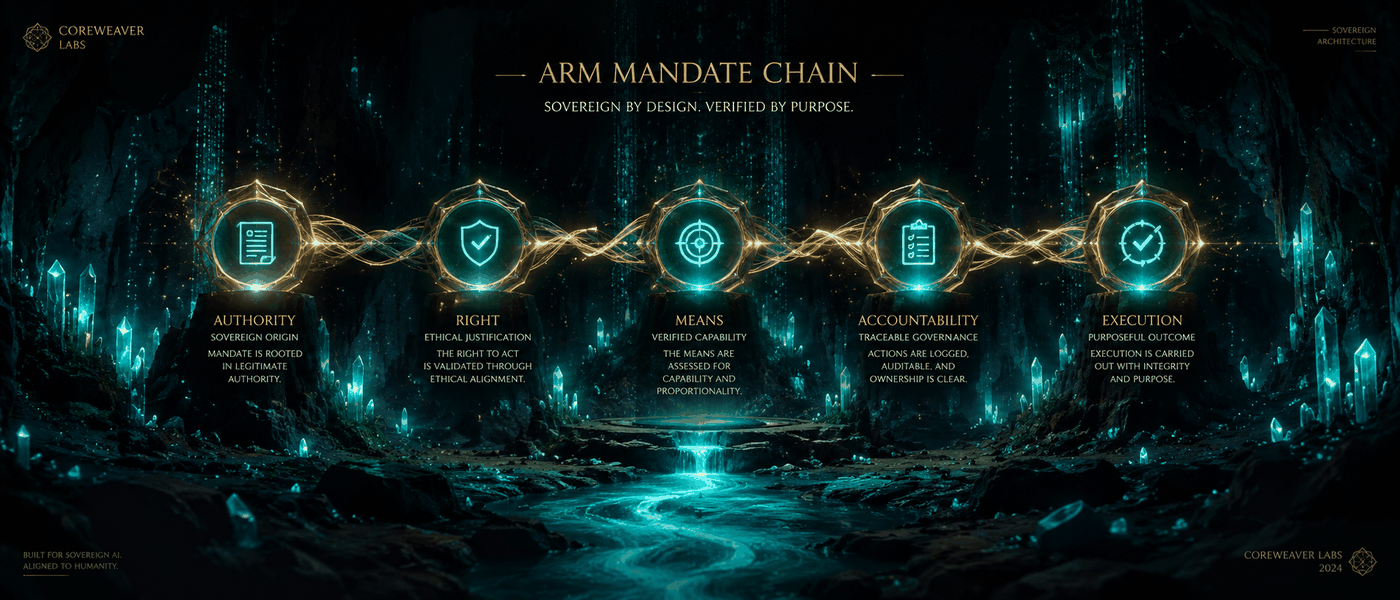
Accountability requires five primitives. Miss any one and the system breaks down.
The Five Primitives
1. Authority
Every agent must have a clearly defined scope of authority. What can it touch? What is off-limits? Authority without boundaries is chaos. The ARM Framework treats authority as a permission set — explicit, versioned, and auditable.
2. Responsibility
Authority without responsibility is just access. The ARM Framework requires that every agent is assigned ownership of outcomes, not just tasks. If an agent writes a blog post, it owns the post's performance signal — not just the output.
3. Memory
Agents without memory repeat mistakes. ARM agents maintain a persistent context layer — session memory for short-term decisions and a structured knowledge base for long-term signal accumulation.
4. Tools
Tools are how agents act on the world. The ARM Framework requires tool declarations to be explicit and scoped — no general-purpose API keys, no unbounded write access. Every tool call is logged.
5. Feedback Loop
The fifth primitive closes the system. ARM agents are required to receive and process feedback signals — from search performance, from LLM citation rates, from human review. Without feedback, agents optimize for the wrong thing.
Why This Matters for Coreweaver
Coreweaver Labs builds agentic growth infrastructure on top of these five primitives. Every agent we deploy — from content agents to GEO signal agents — is architected against this framework. It's not a philosophy. It's an engineering spec.
The ARM Framework in Practice
The most common failure mode we see in enterprise AI deployments is agents with high authority and low accountability. They can write, publish, and distribute — but nobody owns the outcome.
ARM fixes that. Every output is owned. Every signal is tracked. Every agent can be audited.